
If you have ever had to compare two fractions like 4/7 and 5/9 in a hurry, you know the struggle. Do you do the long math, or is there an easier shortcut?
Students and teachers have debated this for years. Should you use the traditional common denominator method or the “cheating” butterfly method fractions trick? Today, we are putting them head-to-head to see which approach helps you finish your math homework fastest without losing your sanity.
How to Use the Common Denominator Method
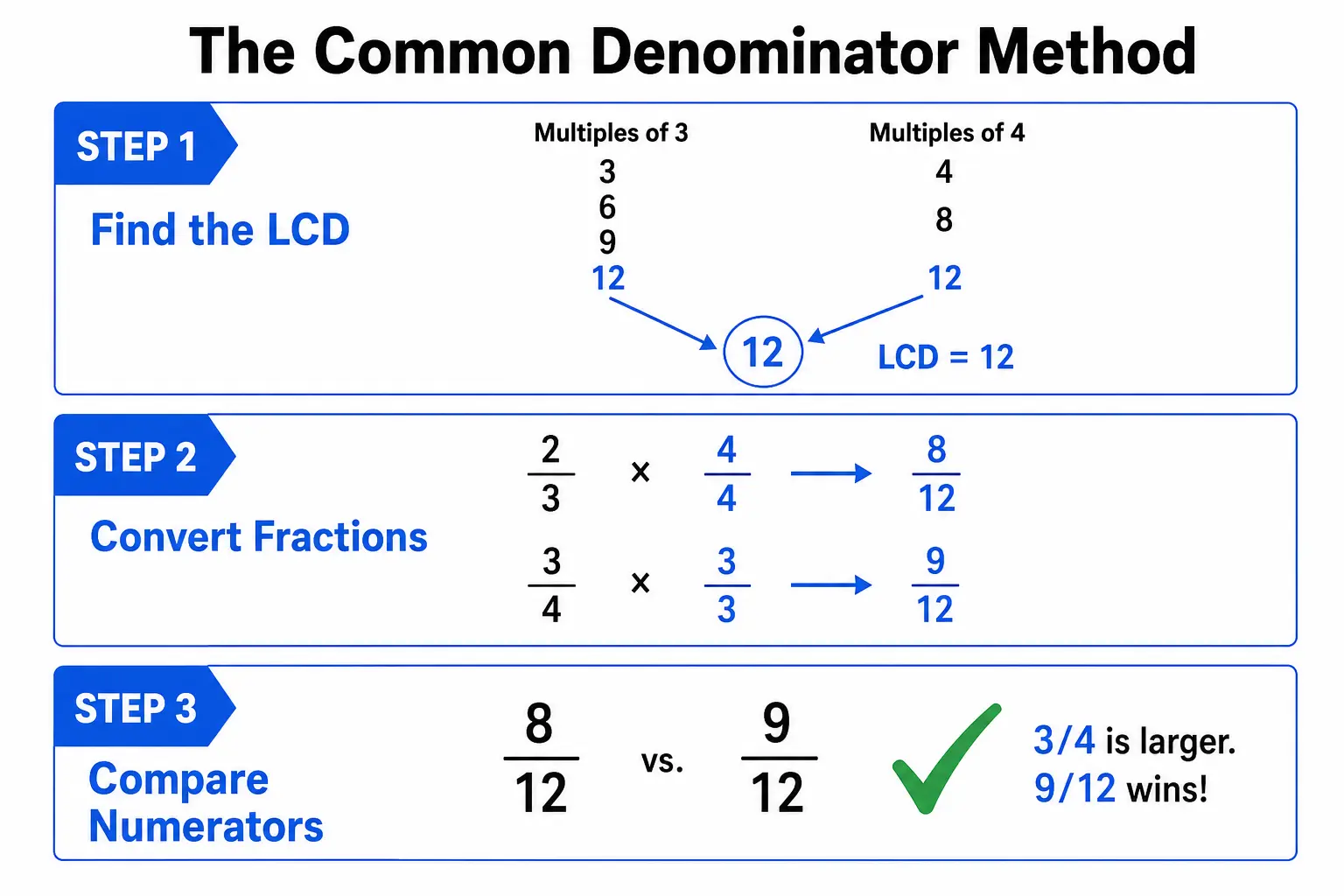
The common denominator method is a traditional mathematical strategy where you find a shared multiple for the bottom numbers of two or more fractions so you can directly compare their top numbers. This is the classic “old school” approach found in every math textbook.
How it works
- Find a common ground: Identify a number that both denominators can divide into perfectly (the Least Common Multiple).
- Convert the fractions: Change both fractions so they share that exact same bottom number.
- Check the tops: Compare the new numerators. The larger top number wins.
Example: Compare 2/3 and 3/4
- The common denominator for 3 and 4 is 12.
- 2/3 becomes 8/12.
- 3/4 becomes 9/12.
- The Result: 9 is bigger than 8, which means 3/4 > 2/3.
The Verdict: It is incredibly reliable for accuracy and handles three or more fractions easily, but it takes more time and paper.
How to Use the Butterfly Method Fractions Shortcut
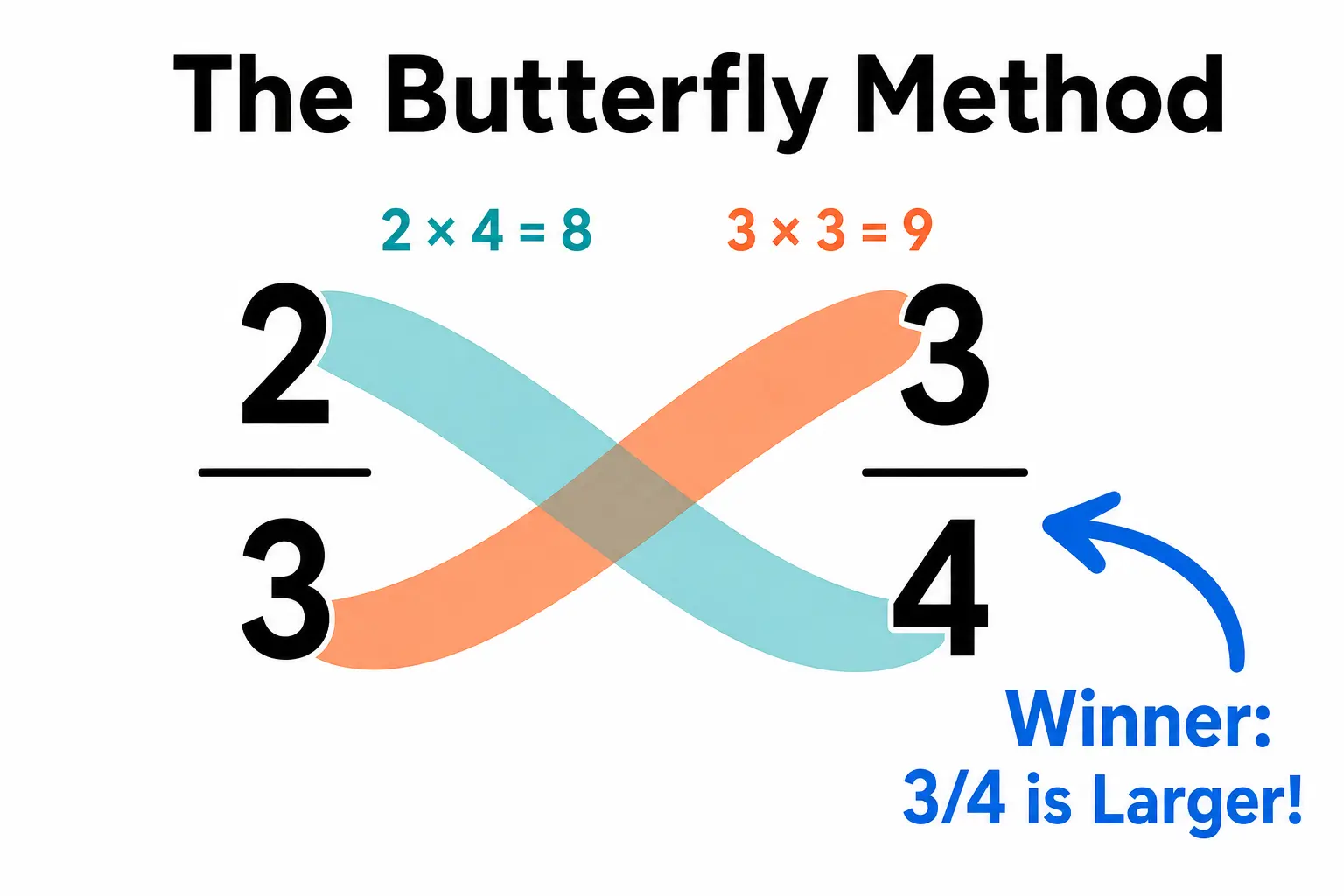
The butterfly method fractions shortcut is a visual cross-multiplication trick that lets you quickly determine which of two fractions is larger without finding a common denominator. It gives you the correct answer in seconds.
How it works
- Wing One: Draw an oval connecting the top-left number with the bottom-right number. Multiply them together.
- Wing Two: Draw a second oval connecting the top-right number with the bottom-left number. Multiply them.
- Compare the products: Look at the two answers resting above your wings. Whichever side has the bigger number is your larger fraction.
Example: Compare 2/3 and 3/4
- Left wing: 2 × 4 = 8
- Right wing: 3 × 3 = 9
- The Result: 9 is bigger than 8, so 3/4 takes the win.
The Verdict: This is lightning-fast for comparing exactly two fractions. It is your best friend for timed tests and quick checks.
The Showdown: Which is Actually Better?
| Feature | Common denominator | Butterfly Method |
|---|---|---|
| Speed | Slower (requires multiple calculations) | Fast (only 2 quick multiplications) |
| Best For | Comparing 3 or more fractions | Comparing exactly 2 fractions |
| Understanding | Shows the actual “why” behind the sizes | Delivers the “answer” quickly |
| Difficulty | Medium effort | Super easy |
When to use common denominators
Let’s be honest: use this when your teacher explicitly says “show your work.” It is also highly useful when you need to add or subtract those fractions immediately afterward because it reinforces how equal-sized pieces line up.
When to use the butterfly method
Use this visual trick if you are in a major rush, tackling a multiple-choice exam, or just want to verify a gut feeling on your homework.
How to Compare Fractions Without the Stress
Whether you prefer the visual wings of cross-multiplication or the rock-solid logic of common denominators, human error happens. If you are stuck or tired, one tiny multiplication slip can ruin your whole answer.
That is exactly why we built the RapidRatio Comparing Fractions Calculator.
Why use our tool?
- See Both Styles: The calculator provides the decimal equivalents and shows the common denominator logic side by side.
- Zero Guesswork: High-precision arithmetic ensures you never get tripped up by annoying rounding errors on your assignments.
- Visual Proof: Clear layouts make the physical size differences completely obvious.
Before doing the heavy lifting by hand, try the RapidRatio Fraction Comparison Calculator to see the step-by-step logic in real time!
Open Fraction Comparison Calculator
Frequently Asked Questions
- Does the Butterfly Method work for mixed numbers?
- Yes, but here is the real trick: you must convert them to improper fractions first to keep the math clean and avoid confusion.
- Is the Butterfly Method “cheating”?
- Not at all. It is just a condensed, faster version of the traditional common denominator process. It is completely sound math wrapped up in a visual shortcut.
- What is the fastest way to compare 1/2 and 1/3?
- If your top numbers are both 1, look at the bottom. The fraction with the smaller denominator always gives you a larger piece. So, 1/2 is naturally bigger than 1/3.